

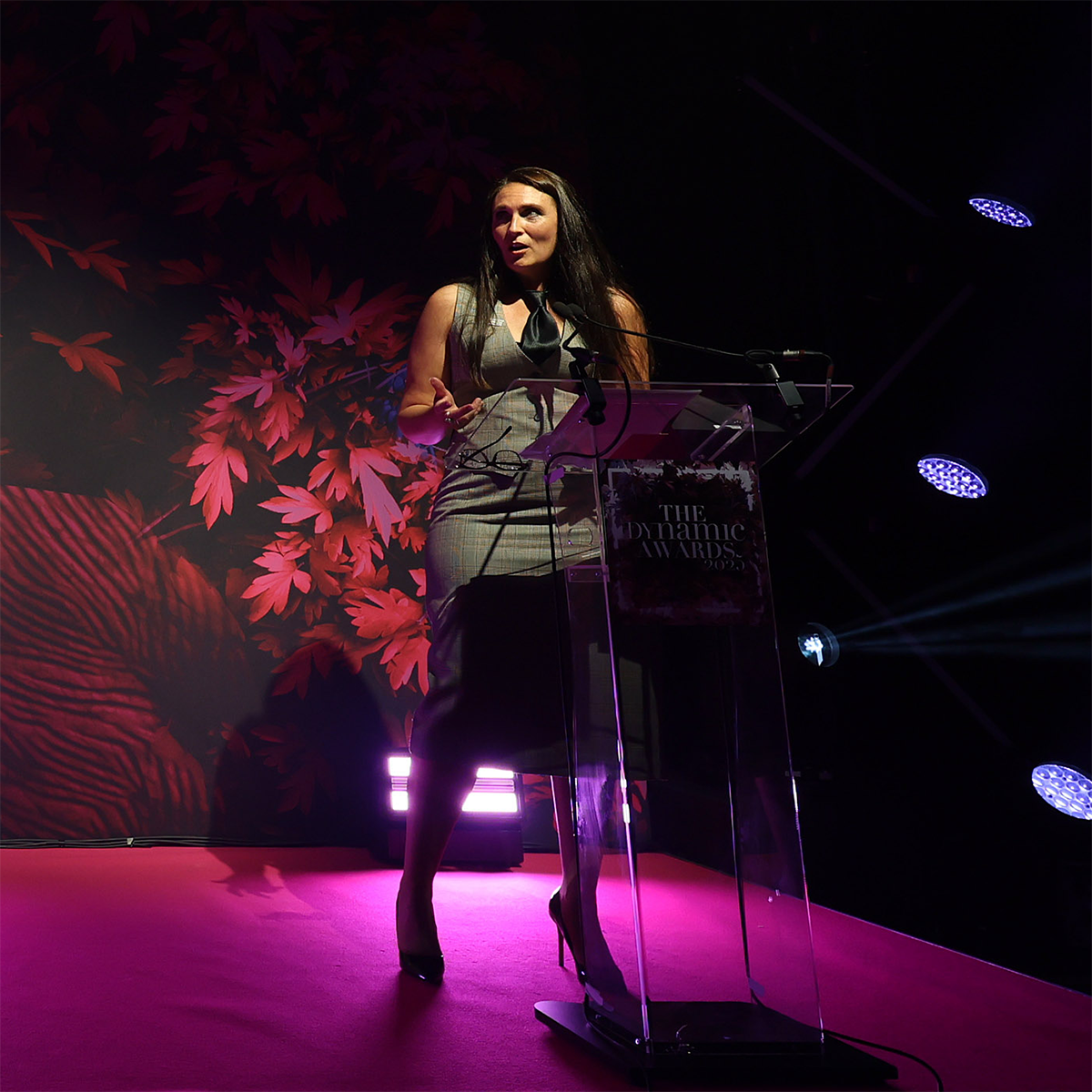

It’s taken nearly a decade for me to take myself seriously as a business owner. Since starting the City Girl Network in 2016, I’ve been told I’m a “one to watch”, “very impressive”, and introduced as the one with the “massive community.” We’re one of the largest women’s networks in the UK – second only to the mighty WI – with a spending power of £2.2bn. But I didn’t believe any of the compliments that I was given.
My response would always be “thank you, but…” followed by my informing them of another brilliant entrepreneur doing better than me. Simultaneously, I would be having a conversation in my head highlighting every reason why I’ll never find the same success.
I’m a very ordinary middle-class person; born in Luton, state-educated, 2:1 degree, 30-something with a dog and a long-term relationship. My dad’s a retired accountant, and my mum’s an SEN teaching assistant, and they live a comfortable life in Milton Keynes.
My height of rebellion was stealing my parents’ vodka for a park drinking session and filling it back up with water (sorry about that, Mum) when I was 16. I have no piercings, tattoos nor dyed hair (except that one time in 2010 when I dyed my hair red to be Florence and the Mach
There’s no “rags-to-riches” or “riches-to-richer” story here, not like the school dropouts or the Oxbridge graduates, whose stories of grit and glamour trample on the mundanity of my existence.
Who would invest in this ordinary woman versus them? Nobody.
Please, no sympathy feelings here. It’s entirely true: nobody would invest in a person who spends precious time and energy drowning herself through comparison taunting. It’s hard to remember that £2.2bn spending power statistic through a description that screams “nothing to see here”.
I grew up as an entrepreneur in the ‘#Girlboss’ era: bingeing the StartUp Podcast, devouring Eric Ries’ ‘The Lean StartUp’ and reciting every word of Simon Sinek’s ‘Start with Why’ TED Talk. I joined an entrepreneurial accelerator, dreaming that Y Combinator would be next, with an office in Silicon Valley thereafter.
I genuinely believed that the only way I could build the City Girl Network was if I were a stereotypical young unicorn. I was four years older than Mark Zuckerberg when he started Facebook and was deeply fearful that I was running out of time (i.e., the ripe old age of 23). And when I didn’t make the Forbes 30 Under 30 list, I felt like I’d failed. It’s no wonder that the Entrepreneurial Economy is worth billions; the Comparison Culture fuels it.
Social Comparison Theory, coined by Leon Festinger in 1954, explains the primitive drive within people to compare themselves with others in order to evaluate their own worth. When it comes to marking professional success, those who don’t have a clear benchmark rely on comparison as a default tool for self-evaluation.
There are two types of comparison: assimilative and contrastive. Assimilative comparison refers to the feeling of “if they can do it, so can I”; contrastive comparison undermines self-confidence by revealing gaps between oneself and others with “I could never be them.” A study in 2009 found that comparative thoughts comprise 12% of our daily mental activity, though I fear that the rise of social media has forced this to increase exponentially.
A friend recently heard me share my mundane self-description and called me out for holding back. Two-thirds of British female business owners feel that investors do not take them seriously, and at that moment, I understood why.
70% of female entrepreneurs feel gender stereotypes negatively affect their work, 61% believe they’ve impeded the growth of their business (Cherie Blair Foundation, 2021), and 75% of women executives have experienced imposter syndrome (KPMG).
It’s all in the stories we tell ourselves.
My description is entirely true, but it completely ignores the fact that I have spent the past nine years passionately grafting a social network of real-life people across the UK (and a toe-dip abroad). And the sheer volume of resilience that I have had to endure whilst doing it.
I’m a firm believer that competition is vital for business success. It’s fuelled my business and seen us thrive over the numerous competitors who have been and gone. Yet I seem to compartmentalise the attitudes of the ‘Managing Director’ role as one that I play rather than one that I am.
It’s only in building a pitch deck for my first round of investment funding that I’ve truly understood the damage comparison culture has caused to me and the thousands of women I meet every year. It’s all a deeply entrenched fear of failure and rejection.
It’s about time we stop apologising for not being someone else, and embrace being ourselves.